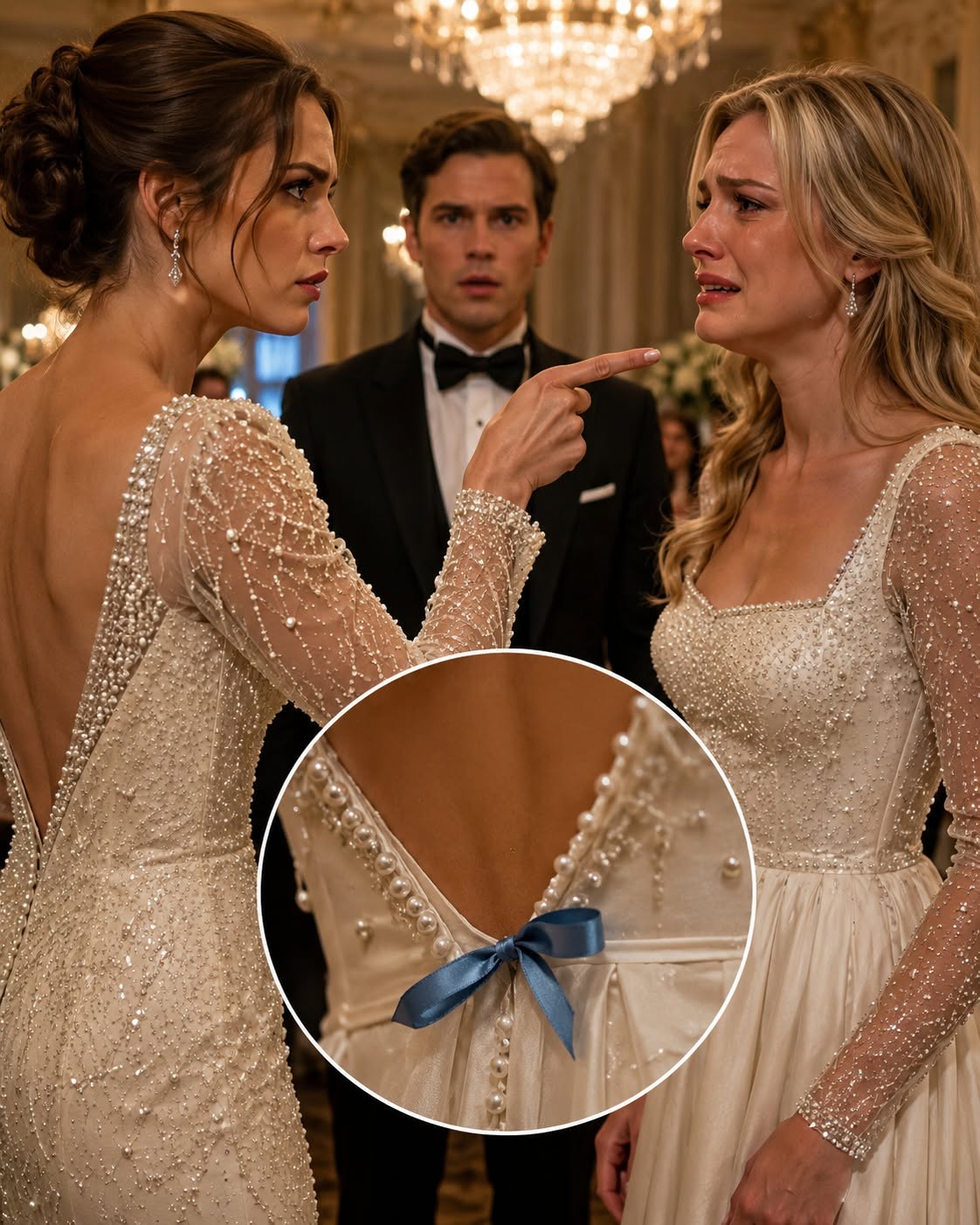
His mistress came to apologize wearing my wedding reception dress.
Not a dress that looked like mine. Not a dress inspired by mine. My actual dress—ivory silk, hand-sewn pearls, a low square back, and a tiny blue satin ribbon hidden inside the waist where my grandmother had stitched my maiden initials with shaking hands the night before my wedding.
She said she wanted peace.
The dress said war.
My husband stood behind her beneath the gold chandeliers of The Plaza Hotel, too ashamed to meet my eyes, while four hundred Manhattan donors, two news cameras, three lifestyle influencers, and half the board of Mercer Hotels watched the moment unfold in horrified silence.
I let her speak about mistakes, feelings, healing, and forgiveness while the pearls on that stolen dress caught the light like teeth.
Then I smiled.
Because Sloane Knox had dressed like the bride.
But tonight, the wife was going to speak like the judge.
CHAPTER 1 — THE DRESS THAT REMEMBERED EVERYTHING
There are dresses women buy to be beautiful.
There are dresses women save to remember who they were before life began breaking their heart in designer shoes.
Mine lived in a climate-controlled preservation box in a cedar room on the third floor of our brownstone on East 73rd Street. The room smelled faintly of lavender, old wood, and the kind of money that pretends it has no scent. Inside that box was the dress I wore after my wedding ceremony, the dress I changed into when Grant Mercer spun me under white roses in Newport and whispered, “You are the only woman I will ever see in a room.”
That was seven years ago.
Back then, I believed him.
Back then, Grant was still charming in a way that felt like weather. He entered a space and people adjusted themselves around him. He had clean-cut American handsomeness, a Princeton smile, and the kind of family name that opened doors before he even reached for the handle. Mercer Hotels owned marble lobbies in Aspen, Miami, Chicago, and New York. His mother sat on museum boards. His father had a wing named after him at Columbia Presbyterian.
And me?
I was Vivian Hartwell then. A girl from Savannah with a dead mother, a steel-spined grandmother, and a scholarship that got me into Columbia before anyone in my family understood what Columbia really meant. I had learned early how to sit in rooms where people measured your worth by the label on your coat, the school on your resume, and the last name attached to your dinner invitation.
Grant made me feel chosen.
That was the first luxury he gave me.
The second was loneliness.
For the first three years of our marriage, he adored me publicly and forgot me privately. At galas, his hand rested at the small of my back like a signature. In interviews, he called me his “true north.” On Christmas cards, we looked like something framed in a Fifth Avenue window: him in navy velvet, me in champagne satin, both of us smiling as if our marriage had central heating.
But at home, Grant belonged to his phone.
read more in next page